Budgeting Tools for Students: Free Spreadsheets & Loan Calculators
Free spreadsheets, calculators, and guides designed specifically for student finances — tuition, loans, textbooks, meal plans, and living expenses.
What You'll Get
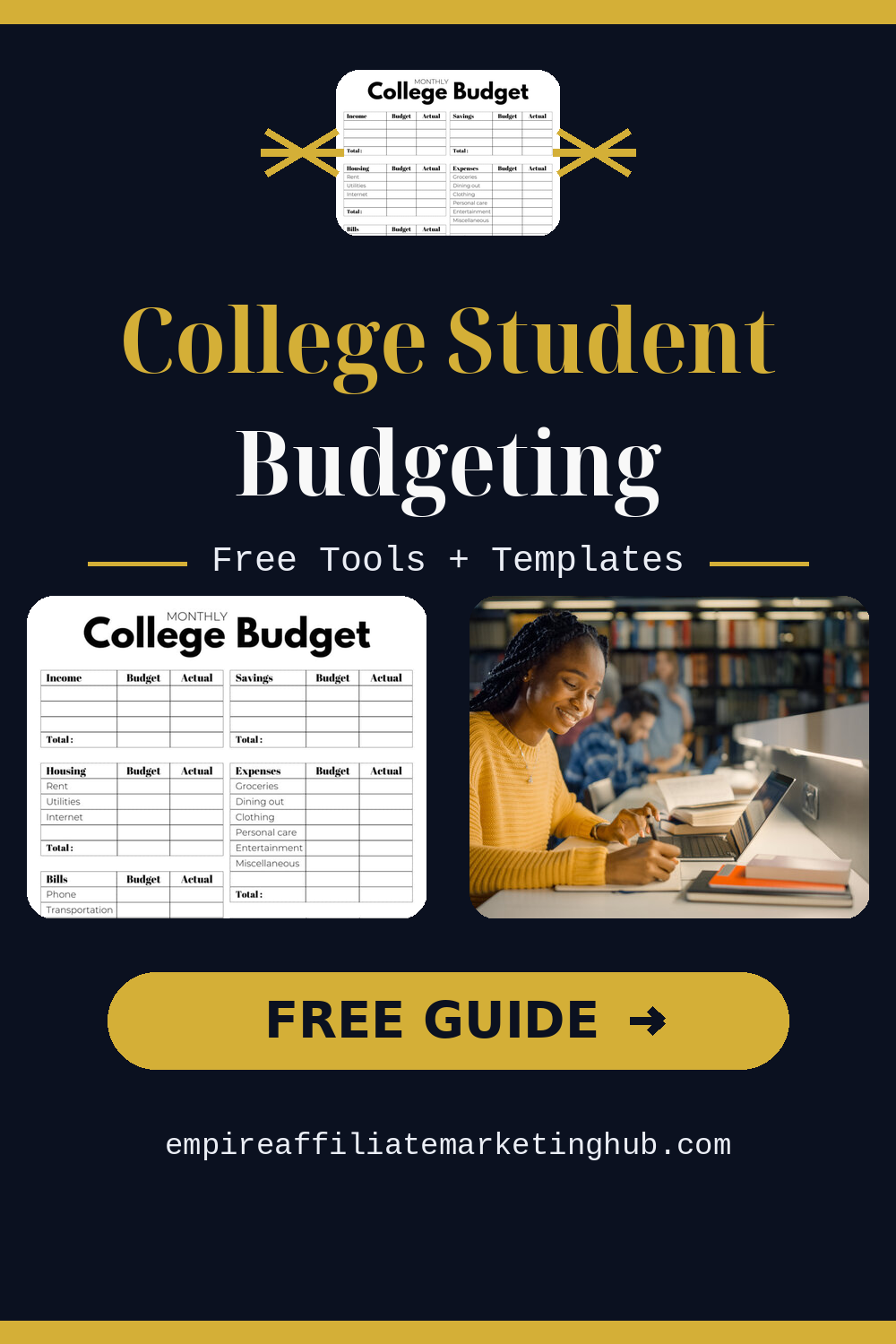
6 Downloads- Student Budget Spreadsheet (Excel + Sheets)
- Loan Repayment Calculator
- Part-Time Job & Income Tracker
- Textbook Savings Guide
- Meal Plan Optimizer
- Scholarship Search Guide
Bookmark this page — your free download unlocks instantly once you complete one quick step.
👇 Click any offer below to unlock your free download. Most take under 30 seconds.
Download Unlocked!
Your complete student budget toolkit is ready. Click below to download.
Download NowWhy Students Need A Budget — And Why Most Don't Have One
Student loan debt in the United States has surpassed $1.7 trillion. The average graduate in 2025 leaves school with $37,000 in debt — a number that grows every year. But research consistently shows that students who budget graduate with 30–40% less debt than those who don't. Not because they earn more, but because they spend more intentionally.
The problem isn't that students don't want to budget. It's that most budgeting tools are designed for adults with steady paychecks and predictable expenses. Student finances are different: income is irregular (financial aid disbursements, part-time job shifts, parental contributions), expenses spike at the start of each semester (textbooks, supplies, deposits), and the biggest expense — tuition — is often handled separately from day-to-day spending.
This toolkit was designed specifically for student cash flow. Every spreadsheet accounts for semester-based cycles, every calculator includes student-specific variables, and every guide was written for someone managing money for the first time.
What's Included In This Free Student Toolkit
Student Budget Spreadsheet
Tracks semester-based income (financial aid, part-time jobs, parental support) and organizes expenses by category. Includes visual spending breakdowns and semester comparison.
Loan Repayment Calculator
Input your loan details and see total repayment costs under standard, income-driven, and avalanche payoff strategies. Includes interest-only payment savings during school.
Part-Time Job Tracker
Log hours and earnings across multiple jobs or gigs. Calculates effective hourly rate after taxes and commuting costs. Helps you decide which jobs are worth your time.
Textbook Savings Guide
A step-by-step checklist for finding the cheapest textbook option for every class. Covers rental, used, previous edition, OpenStax, library reserves, and group-buy strategies.
Meal Plan Optimizer
Calculates whether your campus meal plan is worth the cost based on your eating habits. Compares meal plan price per meal vs. cooking at home vs. buying individually.
Scholarship Search Guide
The best free scholarship databases, how to find local and niche scholarships with less competition, and application templates. Includes a deadline tracker.
The 50/30/20 Rule — Adapted for Students
The classic budgeting rule (50% needs, 30% wants, 20% savings) is designed for working adults. Students need a different framework. Here's how it adapts:
Needs (60%)
Rent, utilities, groceries, transportation, insurance, phone, required course materials, minimum debt payments. Food is at the top because it's the most variable.
Wants (25%)
Dining out, coffee shops, entertainment, subscriptions, hobbies, clothing beyond essentials, gifts. This is where most student budgets leak — tracking the details here reveals $50–$200/month in unnecessary spending.
Savings & Debt (15%)
Emergency fund, extra loan payments, savings for next semester's textbooks, retirement (if working). Even $25/month builds a $300 emergency fund in a year.
Example: $1,800/month take-home
| Category | Percentage | Dollar amount |
|---|---|---|
| Needs | 60% | $1,080 |
| Wants | 25% | $450 |
| Savings & debt | 15% | $270 |
If your actual spending doesn't match this framework, that's the first clue where to adjust. Most students overspend on "wants" (dining, subscriptions) and underspend on "savings" without realizing it.
Typical Monthly Student Expenses — And How To Cut Them
Understanding where your money goes is the first step to keeping more of it. Here's a breakdown of average monthly student expenses with a savings tip for each category:
| Category | Typical Range | Savings Tip |
|---|---|---|
| Food & Dining | $200–$500 | Meal prep Sundays cuts this in half |
| Transportation | $50–$200 | Use your student transit pass (often free) |
| Personal Care | $30–$80 | Campus health center is included in tuition |
| Entertainment | $50–$150 | Free campus events + student streaming discounts |
| Phone & Internet | $30–$80 | Mint Mobile / Visible start at $15–$25/mo |
| Textbooks & Supplies | $100–$300 (semester) | Never buy new from the campus bookstore |
Textbook Price Comparison — Same Book, 8 Prices
Here's a real-world comparison using a typical college textbook (list price $180) to show how much you can save by shopping around:
| Where to Buy | Price | Savings |
|---|---|---|
| Campus bookstore (new) | $180 | Baseline |
| Amazon (new) | $142 | 21% |
| Campus bookstore (used) | $135 | 25% |
| Amazon (used) | $89 | 51% |
| Chegg (semester rental) | $45 | 75% |
| ThriftBooks (used) | $38 | 79% |
| Previous edition (used) | $12 | 93% |
| OpenStax / Library reserve | $0 | 100% |
Over four years and roughly 40 textbooks, buying the cheapest option each time can save you $3,000–$5,000 compared to buying new from the campus bookstore. That's a semester of tuition at many schools.
The Rules for Buying Textbooks
- Wait until the first class. Many professors don't actually require the textbook or provide it for free.
- Ask about previous editions. Most textbooks change 5% between editions. Your professor will tell you if the older version is fine.
- Check the library first. Most campus libraries keep reserve copies you can read on-site or borrow short-term.
- Look for OpenStax editions. These free peer-reviewed textbooks cover many introductory courses.
- Rent instead of buying for one-time courses. Chegg and Amazon both offer semester rentals at 60–80% off.
- Split with a classmate. Buy one copy for every two students and share the cost.
Loan Repayment Calculator — What the Numbers Show
Understanding how student loans actually work changes your decisions. Here's a realistic scenario showing three strategies:
Setup
- Loan amount: $25,000
- Interest rate: 5.5% APR (typical unsubsidized federal loan rate)
- Loan type: Unsubsidized (interest accrues while in school)
- Repayment term: 10 years (standard)
Strategy 1: Pay Nothing While in School (4 Years)
Interest accrues for 4 years, then capitalizes (is added to your principal). You graduate owing approximately $30,950 instead of $25,000. Over 10 years of repayment, you pay $8,700 in total interest. Total paid: $33,700.
Strategy 2: Pay Interest Only While in School ($115/month)
You keep the principal at $25,000 by paying the $115 monthly interest. Over 4 years, you pay $5,520 in interest during school. After graduation, you pay $7,455 in interest over 10 years. Total: $37,975 — but the balance when you graduate is smaller because there's no capitalization.
Strategy 3: Pay $50 Extra Per Month Toward Principal
Starting freshman year, you pay $115 interest + $50 principal = $165/month. Over 4 years, you reduce the balance to approximately $22,600. After graduation, your 10-year repayment includes $6,720 in interest. Total paid: $36,840 across 14 years — but the loan is much smaller when you graduate.
The Real Takeaway
The single biggest win is preventing capitalization. Even paying just the interest while in school saves you thousands compared to deferring everything. And paying extra principal while in school compounds the savings.
The included loan calculator lets you test all three strategies with your actual numbers, so you can see the exact savings for your situation.
Frequently Asked Questions
What is the best budgeting tool for college students?
The best budgeting tool depends on your needs. A spreadsheet is ideal for students who want full control and zero cost — it tracks irregular income (financial aid, part-time jobs, side gigs) and categorizes expenses by semester. Free apps like YNAB (free for students) work well for automated tracking. This toolkit includes both: a custom spreadsheet designed for student cash flow and a guide to the best free budgeting apps.
How much should a college student budget per month?
The average college student spends $1,000–$2,000 per month on living expenses (excluding tuition and housing). A typical breakdown: food $200–$500, transportation $50–$200, personal care $30–$80, entertainment $50–$150, phone $30–$80, and miscellaneous $100–$300. The budget spreadsheet helps you customize these categories based on your location, lifestyle, and income level.
How can students save money on textbooks?
Students spend an average of $1,200 per year on textbooks. You can cut that by 60–80% by: buying used on Chegg or ThriftBooks, renting instead of buying, using OpenStax free textbooks, checking campus library reserves, buying previous editions, and sharing books with classmates. The textbook savings guide includes a price comparison checklist for every class.
Should students use a meal plan or buy their own groceries?
It depends on your campus and living situation. University meal plans average $4,500–$6,500 per academic year. A student who cooks at home spends $200–$350 per month on groceries ($2,000–$3,500 per year). If you live in a dorm with no kitchen, a meal plan may be your only option. If you have a kitchen, buying groceries almost always saves money. The meal plan optimizer helps you calculate the break-even point.
How do you start paying off student loans while still in school?
For unsubsidized loans, interest accrues while you're in school. Paying even $25–$50 per month toward that interest prevents it from capitalizing after graduation. This can save thousands over the life of the loan. The loan repayment calculator shows you the exact savings from making interest-only payments during school vs. deferring all payments.
What are the best free budgeting apps for students?
YNAB offers free access for college students (normally $14.99/month). Goodbudget uses the envelope method and has a free tier. For spreadsheet lovers, Google Sheets is free and the custom spreadsheet in this toolkit is pre-built for student finances. Pick the one you'll actually use — the best budgeting tool is the one you stick with.
Further Reading
For additional guidance on student loans and financial aid, see the Federal Student Aid website and the Consumer Financial Protection Bureau's student loan resources.
Ready To Download?
Scroll back up to the offer cards, click one to unlock your free download, then enter your email to receive it instantly.