Free College Study Resources: Cheat Sheets, Exam Prep & GPA Calculator
Cheat sheets, practice exams, study schedules, and note-taking guides for popular college subjects — completely free.
What You'll Get
6 Downloads- Subject Index for Popular College Courses
- Customizable Study Schedule Template
- Exam Prep Checklists by Subject
- Note-Taking Method Guides (Cornell, Mind Map, Outline)
- Pomodoro Focus Timer Guide
- GPA Calculator Spreadsheet
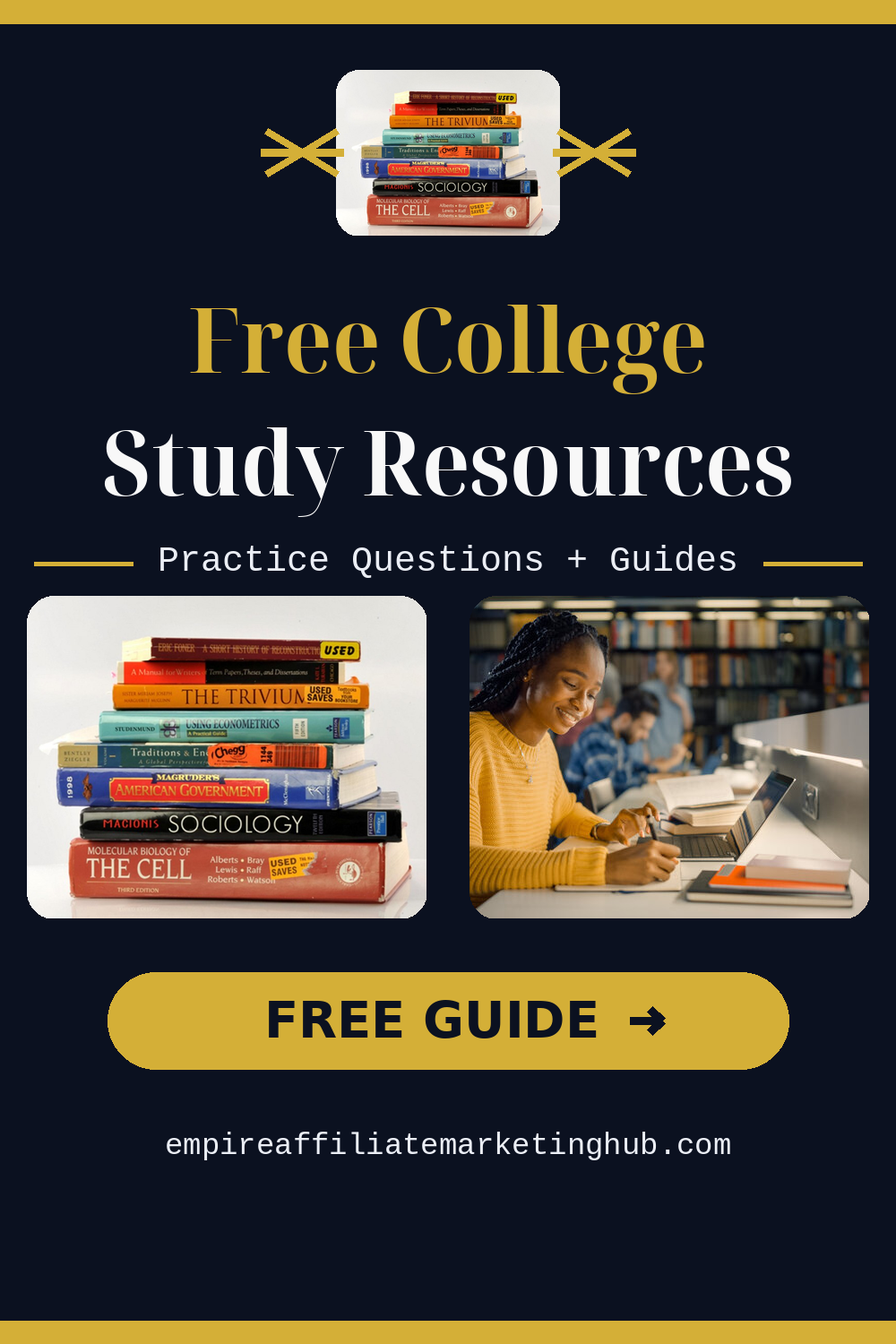
Bookmark this page — your free download unlocks instantly once you complete one quick step.
👇 Click any offer below to unlock your free download. Most take under 30 seconds.
Download Unlocked!
Your complete college study resource pack is ready. Click below to download.
Download NowWhy Good Study Habits Matter More Than Intelligence
Research from the University of California found that students who use structured study methods score 20–30% higher on exams than students who rely on passive re-reading. The difference isn't talent — it's technique. Students who use active recall, spaced repetition, and structured note-taking consistently outperform their peers regardless of their natural aptitude.
The average college student studies 15–20 hours per week, but most of that time is spent inefficiently. Highlighting textbooks, re-reading notes, and cramming the night before an exam are among the least effective study methods according to cognitive science. Yet they remain the most popular because they feel productive — you're moving your eyes across text and it seems like learning.
This free resource pack replaces guesswork with proven systems. The study schedule template allocates time based on difficulty and exam weight. The note-taking guides teach three methods that force active processing. And the Pomodoro focus timer ensures you study in optimal 25-minute intervals with built-in breaks to prevent burnout.
What's Included In This Free Resource Pack
Subject Index
Covers STEM, humanities, business, and social science courses with topic breakdowns and key concepts.
Study Schedule Template
Weekly planner that allocates study time based on course difficulty, exam dates, and credit hours.
Exam Prep Checklist
Step-by-step checklist for each exam: what to review, when to start, and how to practice.
Note-Taking Methods
Guides for Cornell notes, mind mapping, and the outline method with templates and examples.
Focus Timer Guide
Pomodoro technique instructions with recommended session lengths by subject type.
GPA Calculator
Track your current GPA and calculate what grades you need to reach your target.
The 7 Study Methods That Actually Work
Here are the note-taking and study methods included in the pack. Each one is backed by cognitive science research.
Cornell Notes
Best for: Lectures and readingsDivide the page into notes, cues, and summary. Write notes during class, add cues after, and summarize at the end. The cues become your self-quiz questions.
Mind Mapping
Best for: Concept-heavy subjectsStart with a central idea and branch outward to related concepts. Visual connections improve memory retention by up to 32% compared to linear notes.
Outline Method
Best for: Structured contentHierarchical notes with main topics, subtopics, and details. Best for subjects that organize naturally into clear categories (history, biology, business).
Active Recall
Best for: Exam preparationClose your notes and write down everything you remember. Then check what you missed. This is the single most effective study technique identified by cognitive research.
The Feynman Technique
Best for: Complex conceptsExplain the concept out loud as if teaching it to a 12-year-old. When you get stuck, you've found your gap. Go back, fill the gap, and continue.
SQ3R Method
Best for: Textbook readingSurvey, Question, Read, Recite, Review. Turn headings into questions before reading. This converts passive reading into active processing.
Pomodoro Technique
Best for: Focus and consistencyStudy in 25-minute blocks with 5-minute breaks. After 4 blocks, take a longer break. Prevents mental fatigue and maintains concentration.
The GPA Calculator Walkthrough
The included GPA calculator does two things: it tracks your current standing and it tells you exactly what grades you need to reach your target GPA.
How GPA Works
Every grade carries points per credit hour:
| Letter Grade | Points |
|---|---|
| A | 4.0 |
| A− | 3.7 |
| B+ | 3.3 |
| B | 3.0 |
| B− | 2.7 |
| C+ | 2.3 |
| C | 2.0 |
| C− | 1.7 |
| D | 1.0 |
| F | 0.0 |
Your GPA is calculated by multiplying each grade point by the credit hours of the course, then dividing the total by your total credit hours.
GPA Example — 3 Courses
Biology (4 credits) — A (4.0): 4 × 4.0 = 16.0
English (3 credits) — B+ (3.3): 3 × 3.3 = 9.9
Math (4 credits) — B (3.0): 4 × 3.0 = 12.0
Total points: 16.0 + 9.9 + 12.0 = 37.9
Total credits: 4 + 3 + 4 = 11
GPA = 37.9 ÷ 11 = 3.45
Setting a Target GPA
The calculator also works backward. If your current GPA is 3.2 and you want to graduate with a 3.5, the calculator shows exactly what grades you need in each remaining semester.
Common GPA Mistakes
- Retaking courses without checking the policy. Many schools replace the original grade; others average both. Check before retaking.
- Ignoring credit hours. A 4-credit course impacts your GPA more than a 3-credit course.
- Cramming for low-credit courses. Better to spend that time on high-credit courses where the impact is larger.
- Ignoring pass/fail options. If a course is hard and not required, pass/fail preserves your GPA.
Exam Prep Checklists by Subject Type
Different subjects require different prep strategies. Here's what to focus on for each type.
STEM Subjects (Math, Physics, Chemistry, Biology)
- Practice problems are more valuable than re-reading notes
- Identify the 5–10 problem types most likely to appear and master those
- Write out every step of the solution — don't skip steps mentally
- Know the formulas cold. The cheat sheets in this pack have the ones you'll need
- Review the day before, but don't try to learn new material
Humanities (Literature, History, Philosophy)
- Know your key quotes and themes
- Practice writing analytical paragraphs under time pressure
- Have 3–5 examples ready for each major theme
- Outline essays before writing — a strong thesis is worth more than length
- Review the timeline of major events (for history)
Social Sciences (Psychology, Sociology, Economics)
- Know the key theories and theorists
- For each theory: theorist, core idea, one supporting study
- Practice applying concepts to real-world scenarios
- Graphs are often tested — know how to interpret and draw them
- Definitions matter. Study the vocabulary.
Business (Marketing, Finance, Management)
- Case study analysis is usually the main exam format
- Know the frameworks (SWOT, PESTLE, Porter's Five Forces) and when to apply them
- Practice calculating financial ratios quickly
- Focus on application, not just memorization
- Current events can appear in questions — stay informed
Frequently Asked Questions
What study resources are included in the free download?
The free download includes a subject index covering popular college courses, a customizable study schedule template, exam prep checklists for each subject, note-taking method guides (Cornell notes, mind mapping, outline method), a focus timer guide with Pomodoro technique instructions, and a GPA calculator spreadsheet.
What is the best study method for college students?
Research shows that active recall and spaced repetition are the most effective study methods. The Cornell note-taking method combined with the Pomodoro technique (25-minute focused sessions with 5-minute breaks) helps students retain 40–60% more information compared to passive re-reading.
How can I improve my GPA in college?
The biggest GPA improvements come from consistent study schedules (not cramming), using active recall instead of passive reading, attending every class, and starting assignments early. The included GPA calculator tracks your current standing and shows what grades you need to reach your target GPA.
Are these study resources free for all subjects?
Yes, all study resources are completely free. The subject index covers STEM, humanities, business, and social science courses. The templates and guides work for any college subject because they teach study methods rather than subject-specific content.
How long before exams should I start studying?
For major exams, start 3–4 weeks before. This allows for spaced repetition — reviewing material at 1 day, 3 days, 7 days, and 14 days intervals. Even 2 weeks of structured studying produces strong results.
Can I use these resources in high school?
Yes. The study techniques and templates work for high school students too, particularly those preparing for AP, IB, or SAT/ACT exams. The GPA calculator is college-specific, but the note-taking and study methods are universal.
Further Reading
For evidence-based study techniques, see the Retrieval Practice research library and the American Psychological Association's resources on learning and memory.
Ready To Download?
Scroll back up to the offer cards, click one to unlock your free download, then enter your email to receive it instantly.