Budget Home Organization: Every Room, Under $50
A complete room-by-room organization system using dollar-store containers, decluttering checklists, and printable labels — transform your space without breaking the bank.
What You'll Get
6 Downloads- Room-by-Room Decluttering Checklists
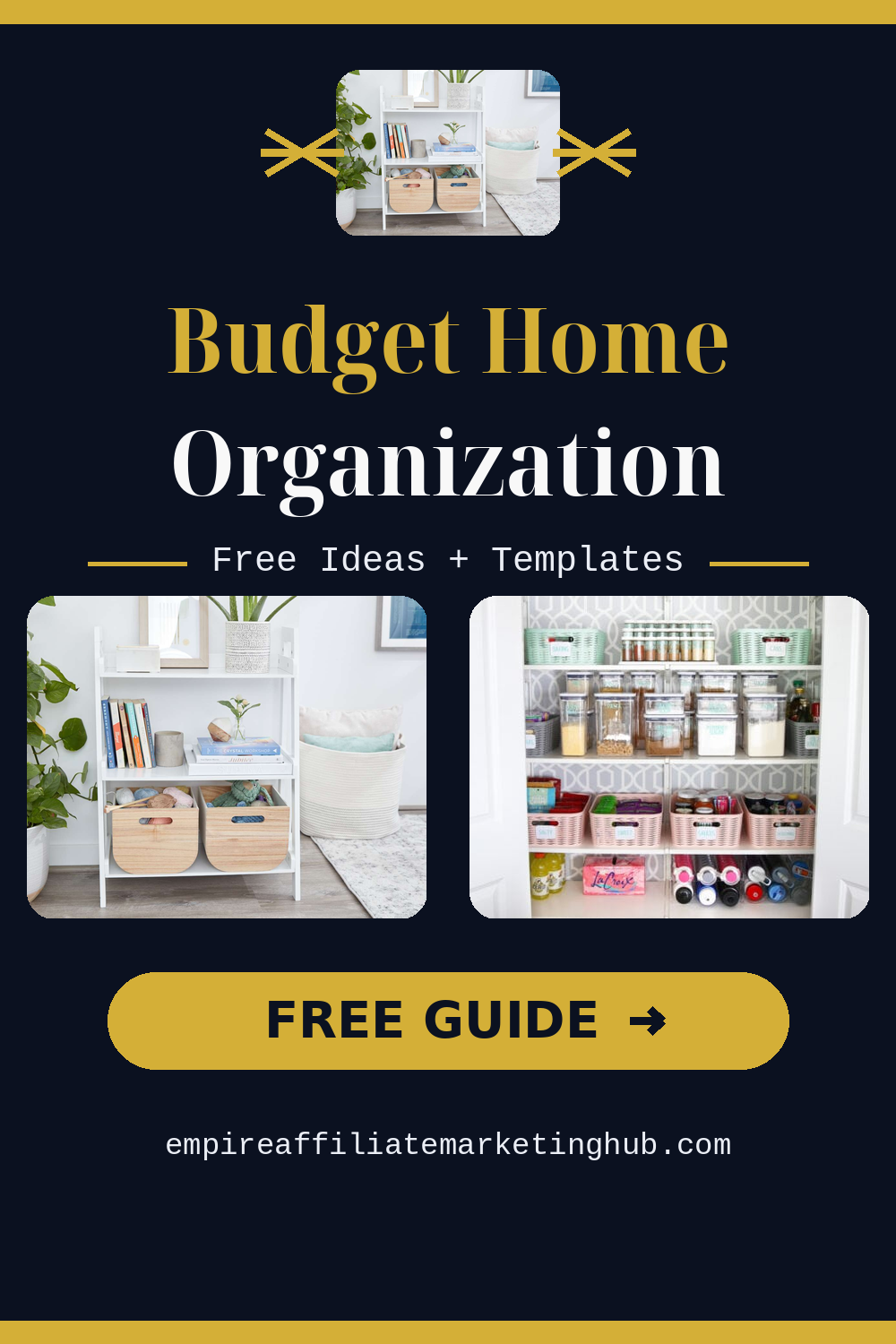
- Dollar-Store Storage Ideas (with photos)
- Printable Labels (pantry, closet, garage)
- 30-Day Organization Plan
- Donation Tracker Spreadsheet
- Maintenance Routine Guide
Bookmark this page — your free download unlocks instantly once you complete one quick step.
👇 Click any offer below to unlock your free download. Most take under 30 seconds.
Download Unlocked!
Your complete home organization guide is ready. Click below to download.
Download NowWhy A Cluttered Home Costs You Money
The average American household contains 300,000 items — and 80% of those items are never used. That's not just a space problem. It's a money problem. Clutter hides the things you already own, so you buy duplicates. It makes cleaning harder, so you hire help or let it slide. And it creates decision fatigue that leads to convenience purchases — takeout, new organizers, "quick fixes" that pile up alongside the original problem.
Organization isn't about being neat. It's about knowing what you have so you stop buying what you don't need. When every item has a home, you spend less, waste less, and find what you're looking for in seconds instead of minutes. That's worth more than the $50 this entire system costs to set up.
This guide covers every room in your home with a specific plan, a supply list, and a realistic time estimate. You don't need fancy containers or a professional organizer. You need a method, some dollar-store bins, and a system to maintain it. All three are in the download.
The Four-Box Declutter Method
Every room in this guide uses the same method: four boxes, fifteen minutes, no overthinking. It's the fastest way to clear any space — and it works whether you're tackling a drawer or an entire garage.
Box 1: Keep
Items you've used in the last 12 months, items you love, items that serve a genuine purpose. Be honest — the "I might need this someday" pile is what got you into this situation. If you haven't touched it in a year, it belongs in another box.
Box 2: Donate
Items in good condition that you don't use. Clothing you haven't worn, kitchen gadgets that seemed useful at the time, books you'll never re-read, gifts you don't love. Someone else will use them. The included donation tracker spreadsheet helps you log them for tax deductions.
Box 3: Trash
Broken items, expired products, things with missing pieces, anything you'd be embarrassed to donate. Be ruthless. Half the clutter in most homes is genuinely garbage that just hasn't been thrown out yet.
Box 4: Relocate
Items that belong in another room. The screwdriver from the kitchen drawer, the book from the bathroom shelf, the mail from the entryway table. Carry this box from room to room as you go — you'll end up putting things away as you clean.
The method works because it removes the biggest barrier to decluttering: indecision. You don't need to decide if something "sparks joy." You just need to decide which of four boxes it goes into. That takes seconds, not minutes.
Room-by-Room Organization Plan
Here's the complete plan for each room in the guide. Each room has a specific checklist, supply list, and realistic time estimate in the download.
🚪 Entryway
45 minutesThe first room guests see and the room where mail, shoes, and bags pile up. The goal is a system that catches everything in under 10 seconds when you walk in the door.
- Wall hooks for keys and bags
- Shoe rack or bin
- Mail sorting station
- Console table or shelf
- Mat for wet shoes
🍳 Kitchen & Pantry
2–3 hoursThe most-used room in the house. The goal is a pantry where you can see everything, a counter with nothing on it, and drawers where you know exactly where each tool lives.
- Clear pantry containers
- Drawer dividers
- Under-sink organizers
- Spice rack
- Fridge bins
👕 Bedroom & Closet
1–2 hoursThe room where clutter is most invisible — under the bed, in the closet, in the back of the drawers. The goal is a wardrobe where you can see everything and reach anything in 2 seconds.
- Matching hangers (reduces visual noise)
- Shoe organizer
- Drawer dividers
- Under-bed storage
- Seasonal bin
🛁 Bathroom
45 minutesThe smallest room but often the most cluttered relative to its size. The goal is a system where every product has a home and cleaning is a 2-minute task.
- Under-sink shelves
- Drawer dividers
- Medicine organizer
- Towel hooks or rack
- Shower caddy
🛋️ Living Room
1 hourThe visible room — everything here is "decor," including the clutter. The goal is a room where every surface is functional and the things you use most are accessible without being visible.
- Baskets for remote controls
- Magazine file
- Media console organizer
- Throw blanket basket
- Side table with drawer
📚 Home Office & Paper
2 hoursPaper is the hardest thing to organize because it accumulates invisibly. The goal is a system where every piece of paper either gets acted on, filed, or thrown out — no more paper piles.
- Document file box
- Shredder
- Action folder
- Archive box
- Bill organizer
Dollar-Store Storage: What To Buy and What to Skip
Dollar stores are the budget organizer's best friend — but not everything is worth buying. Here's what works and what falls apart.
| Buy It | Skip It |
|---|---|
| Clear plastic bins (any size) | Thin fabric bins that sag under weight |
| Drawer dividers (adjustable) | Fixed-size dividers that never fit |
| Spray-painted baskets (transform cheap) | Cardboard boxes labeled "storage" |
| Clear glass jars (for pantry staples) | Cheap plastic containers that stain |
| Adhesive hooks (for keys, towels) | Weak hooks that fall under weight |
| Binder clips (cable management) | Velcro strips that lose grip |
| Contact paper (shelf liner) | Sticky mats that peel off |
| Chalkboard labels (removable) | Permanent labels you'll regret |
The full shopping list in the download organizes everything by category so you can buy it all in one trip for under $50 — including the contact paper, labels, bins, and baskets.
The 30-Day Organization Plan
You don't need a weekend to organize your home. You need 15–30 minutes a day for 30 days. Here's how the plan breaks down:
| Week | Focus | Daily Time |
|---|---|---|
| Week 1 | Entryway, Kitchen counters, Bathroom drawer | 15–20 min |
| Week 2 | Pantry, Kitchen drawers, Under-sink areas | 20–30 min |
| Week 3 | Bedroom closet, Under-bed storage, Dresser drawers | 20–30 min |
| Week 4 | Living room, Home office, Paper system | 30 min |
The Maintenance Routine (The Part Nobody Talks About)
Organizing is easy. Staying organized is the hard part. The guide includes a simple maintenance routine:
- 2 minutes daily: Reset one surface (kitchen counter, entryway table, living room coffee table)
- 15 minutes weekly: Do a quick four-box pass on one room
- 1 hour monthly: Deep-clean one space and reassess what's working
- Seasonally: Rotate seasonal items and declutter anything that hasn't been used
Total time: under 3 hours a week. That's less than the time you currently spend looking for things you can't find.
Frequently Asked Questions
How much does it cost to organize a home on a budget?
You can organize an entire home for under $50 using dollar-store bins, baskets, labels, and repurposed items. The most expensive part is usually decorative storage bins, which can be replaced with basic clear containers or upcycled boxes. The full shopping list in the download totals $47 at dollar-store prices.
What is the fastest way to declutter a room?
The four-box method works fastest: label four boxes Keep, Donate, Trash, and Relocate. Sort every item into one box without overthinking. Anything you haven't used in 12 months goes in Donate or Trash. A typical bedroom takes 1–2 hours with this method; a kitchen takes 2–3 hours.
Where should I start organizing my home?
Start with the room that causes you the most daily stress — usually the kitchen or entryway. Small wins build momentum. The 30-day plan in this guide walks you through one small area per day, starting with the entryway on Day 1.
What is included in the free home organization guide?
The free download includes room-by-room decluttering checklists, dollar-store storage ideas with photos, printable labels, a 30-day organization plan, a donation tracker, and a maintenance routine to keep your home organized long-term.
How do I keep my home organized after the initial declutter?
The maintenance routine is the key. Two minutes a day to reset one surface, fifteen minutes a week for a quick four-box pass on one room, and one hour a month for a deeper clean. This prevents clutter from rebuilding to the original level.
Can I do this in a small apartment or rental?
Yes — the entire system is designed for small spaces and renter-friendly solutions. No permanent installations, no wall-mounted shelving that requires drilling. Everything uses adhesive hooks, freestanding containers, and under-bed storage that comes with you when you move.
Further Reading
For additional evidence-based organization guidance, see the Apartment Therapy organization archives and the Better Homes & Gardens organizing guides.
Ready To Download?
Scroll back up to the offer cards, click one to unlock your free download, then enter your email to receive it instantly.